Bilingual Play · 24 Sept 2026 · Kids Essentials
Turn Puzzle Pictures into Stories in Bangla and English
Turn a puzzle picture into a shared adventure with easy Bangla and English prompts, playful story starters and ideas for ages 1–10.
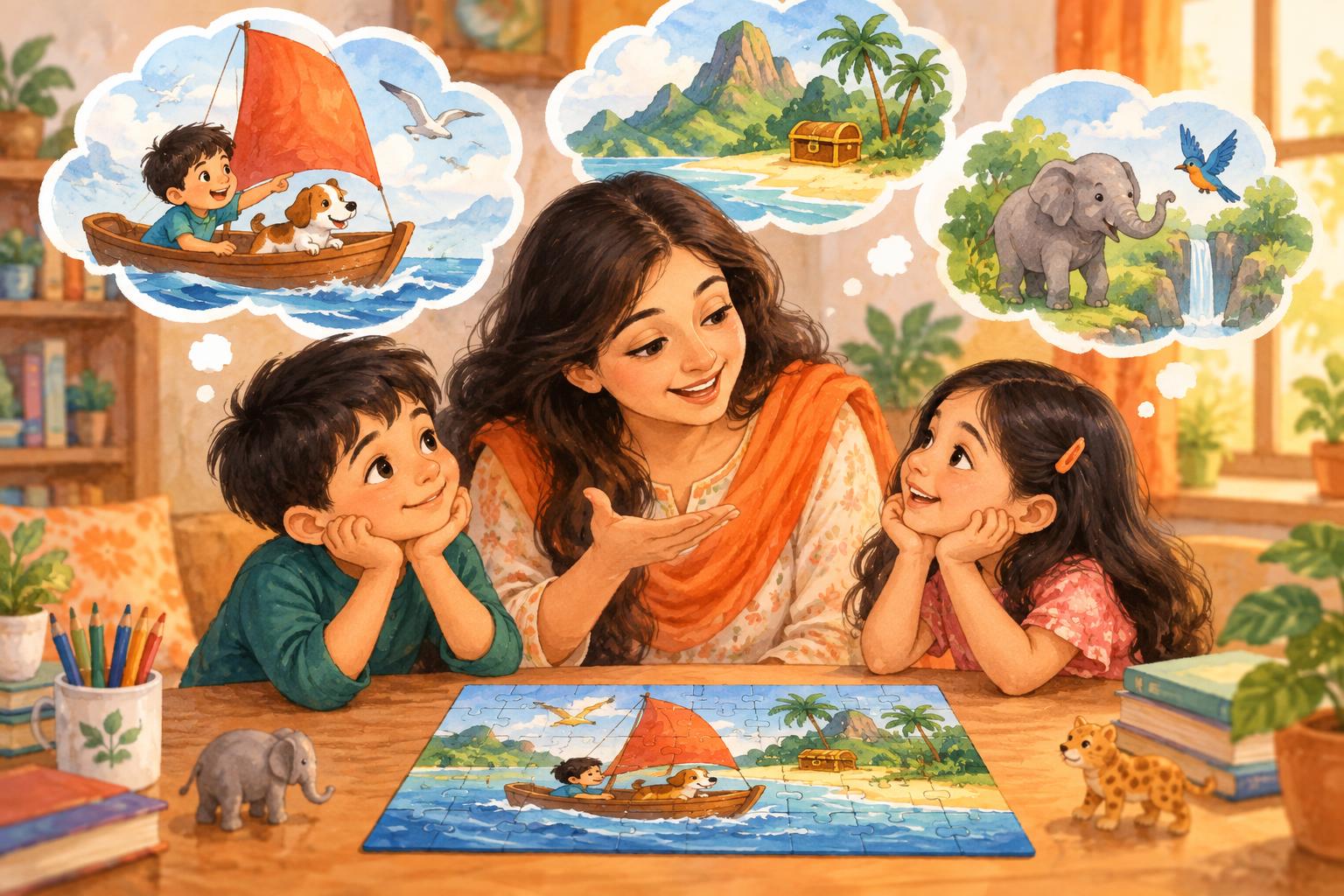
A finished puzzle does not have to mean playtime is over. Its picture can become the beginning of a story: a fish looking for a friend, a train visiting Nanu’s house, or an animal preparing for rain. With a few gentle prompts, you and your child can turn the scene into a conversation in Bangla, English or both.
You do not need perfect English or a prepared lesson. Start with the language your child finds comfortable, follow their ideas and add a little new language along the way.
Start with looking, not testing
Sit beside your child so you can both see the picture. You can use a completed puzzle or its reference picture; finishing every piece is not a requirement. Choose a theme your child already enjoys. Browse wooden puzzles together, or simply use one you have at home.
For younger children, check the product’s age guidance and keep small pieces away from children who may mouth them. An adult can hold the reference picture for a toddler while loose pieces stay out of reach.
Begin with a comment rather than several questions: “I wonder where this character is going.” Then pause. Pointing, making a sound or saying one word all count as joining in.
Build a story with three small steps
1. Choose someone to follow
Let your child select a person, animal or vehicle from the picture. Give it a name and a wish. A train might want to reach a station; a fish might want someone to play with.
- Bangla: “ওর নাম কী? ও কী করতে চায়?”
- English: “What is their name? What do they want to do?”
2. Add a small surprise
Keep the problem gentle: it starts raining, a friend is late, or the character takes a wrong turn. Ask, “তারপর কী হলো?” or “What happened next?” If your child gets stuck, offer two choices: “Did they find a bridge or ask a friend?”
3. Find an ending together
Ask how the character could solve the problem. Accept funny answers—a talking umbrella is welcome in an imaginary story. Finish with “শেষে…” or “In the end…” and repeat your child’s ending back to them.
Try a short bilingual conversation
A train theme, such as the Train Wooden Puzzle, can prompt an imaginary family journey. The details below are invented for storytelling, not descriptions of the product picture.
- Parent: “ট্রেনটা কোথায় যাচ্ছে?” “Where is the train going?”
- Child: “নানুর বাসায়!”
- Parent: “Yes, it is going to Nanu’s house. Who is on the train?”
- Child: “আমি আর একটা বিড়াল।”
- Parent: “You and a cat! বিড়ালটা কী বলছে?”
- Child: “Meow! I am hungry!”
- Parent: “What happens next?”
You do not need to say every sentence twice. Ask in Bangla, add an English phrase naturally, then continue in whichever language keeps the story moving.
Match the conversation to your child
- Ages 1–2: Name one visible thing, point and copy sounds. Try “মাছ—fish” with a swimming hand movement. A shared sound or gesture is enough; a complete story is unnecessary.
- Ages 3–5: Use short questions and choices. “Is the rabbit happy or sleepy?” Take turns adding one sentence, with actions or silly voices.
- Ages 6–7: Try a beginning, middle and end. Introduce “first,” “then” and “finally” alongside “প্রথমে,” “তারপর” and “শেষে.”
- Ages 8–10: Invite dialogue, reasons and different viewpoints. “Why did the character change their mind?” Let your child tell the same event from another character’s perspective.
These are starting points, not targets. Follow your child’s interests and communication comfort rather than expecting a particular sentence length.
Add English without interrupting the fun
Choose just two or three useful words from the story, such as “friend,” “lost” and “help.” Repeat them naturally instead of asking your child to memorise them. If they say, “Fish go home,” you can reply, “Yes, the fish is going home,” and carry on without demanding a correction.
Mixing languages is welcome in this activity. If your child answers entirely in Bangla, respond to the idea first. You can offer one short English sentence, but there is no need to make them repeat it.
End while everyone is still enjoying it
A few minutes can be enough. Stop when your child loses interest, or invite them to draw the next scene. For another day, explore imaginative play ideas and let them choose a new adventure.
The aim is not a flawless story or equal amounts of both languages. It is a warm exchange where your child’s ideas matter—and where an ordinary puzzle picture gives you something wonderful to talk about together.