
Early Maths · 15 Oct 2026 · Kids Essentials
Simple Maths Games with Puzzle Pieces: Counting, Grouping and Comparing
Turn puzzle pieces into simple counting, sorting and comparing games, with practical ideas for different ages.
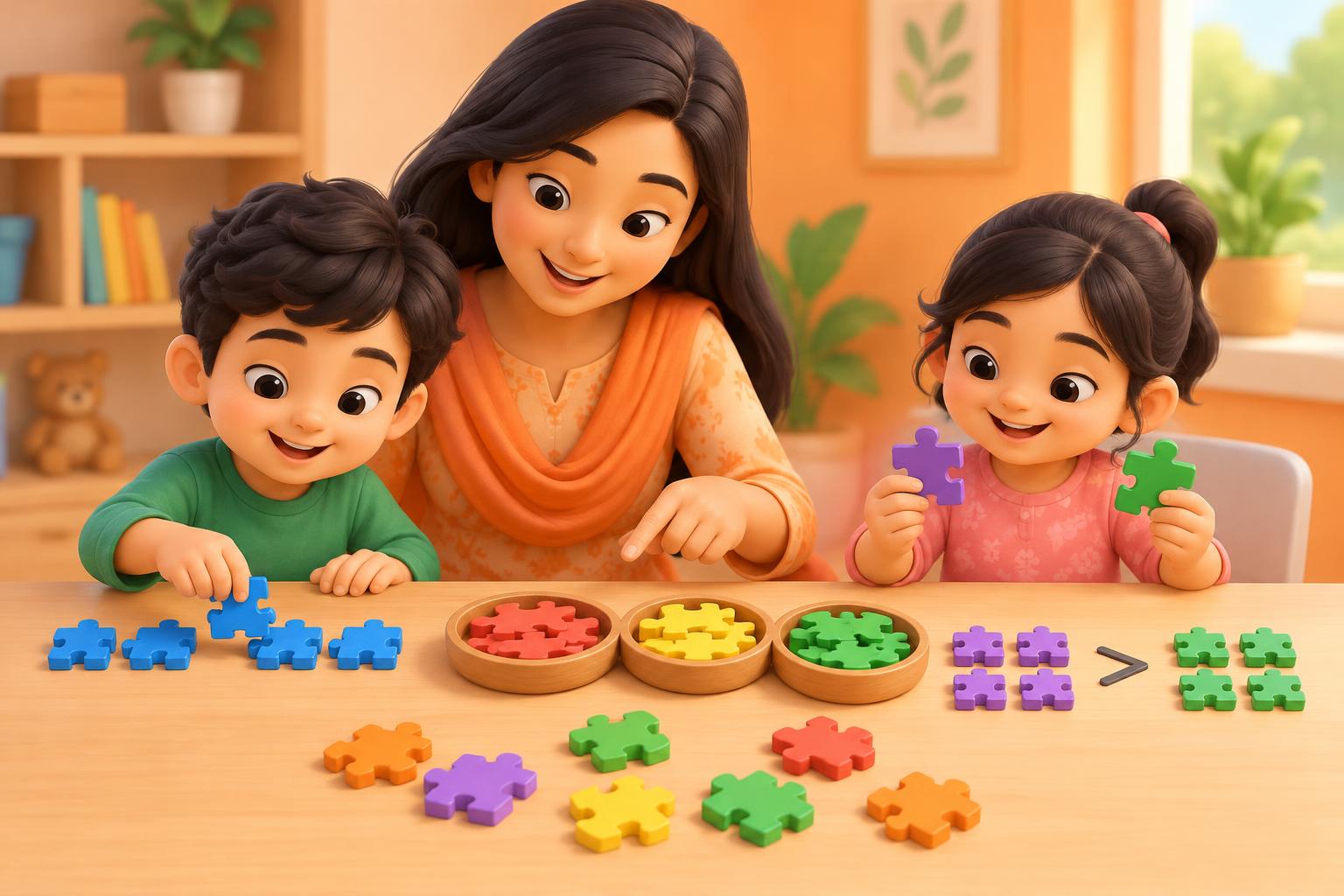
Puzzle pieces can do more than complete a picture. Before putting them together, you and your child can use a few pieces to explore numbers, make groups and compare amounts. There is no need for worksheets or a special maths lesson: a clear space and a little conversation are enough.
Try one game during a quiet afternoon at home. Count in Bangla, English or whichever language feels natural. Understanding the idea matters more than getting every number word right.
Set up a small, safe play space
Choose pieces that are appropriate for your child’s age, following the product’s age guidance and warnings. Small puzzle pieces are a choking hazard, particularly for children under three or anyone who still mouths objects. Supervision does not make small pieces suitable. For a one- or two-year-old, only use large, age-appropriate pieces without detachable small parts; otherwise, save these games for later.
- Use pieces from one puzzle so different sets do not get mixed up.
- Start with three to five pieces, adding more only when useful.
- Play on a clear mat or table, away from younger siblings.
- Keep pieces dry and avoid bending them or forcing them together.
If you are choosing a set, browse wooden puzzles and check the individual product details. Material alone does not tell you whether a puzzle is suitable for your child.
1. Touch, move and count
Place three pieces in a row. Invite your child to move each piece into a separate space while saying one number per piece: “One, two, three.” Moving pieces helps make it clear which ones have already been counted.
Then ask, “How many pieces do we have altogether?” Repeat the final number: “Three. We have three pieces.” This connects the counting sequence with the total amount.
- Make it easier: Use two pieces and count together.
- Add a challenge: Ask your child to give you exactly five pieces from a larger pile.
- Explore further: Spread the counted pieces apart. Ask whether the amount changed, then count again to check.
If your child skips a piece, avoid turning it into a test. Say, “Let’s move them one at a time and see.”
2. Make groups with one simple rule
Choose a visible feature and sort the pieces into two groups. For example, try “pieces with some blue” and “pieces with no blue”. These rules are clearer than asking children to sort by colour when each piece contains several colours.
Ask your child to explain a choice: “What made you put this one here?” If a feature is difficult to see, choose a different rule together. Where the puzzle allows it, try pieces with a straight edge and pieces without one.
Count each group afterwards. Then mix the pieces and use a new rule. Explain that the same pieces can belong to different groups depending on what you are looking for.
3. Compare more, fewer and the same
Make one group of three pieces and another of five. Ask, “Which group has more pieces? How could we check?”
Arrange the groups in two rows, pairing one piece from each row. The group with unpaired pieces has more. This makes the comparison visible without relying only on how large a pile looks.
Use clear language: “This row has more pieces. That row has fewer.” Then ask your child to make both rows have the same number by adding or removing pieces.
Compare the number of pieces, not the space they cover. Three large pieces may cover more space than five small ones. For older children, this can become an interesting discussion.
4. Share pieces fairly
Put out six pieces and mark two spaces on a sheet of paper. Pretend these are places for two family members. Ask your child to share the pieces equally, dealing one to each space in turn.
Count each share: “Three here and three there. Both have the same.” For a child ready for more, try seven pieces between two spaces. Discuss the one left over rather than cutting or breaking a piece.
Older children can arrange twelve pieces into groups of two, three or four. Ask how many groups they made and whether anything remains. Pieces from paper puzzles can be used for this too, provided they are age-appropriate and handled gently.
Keep the games playful
Choose the challenge by what your child can comfortably do, not age alone. Younger beginners may enjoy counting two pieces; older children may enjoy predicting totals before checking. Ask “How did you work that out?” rather than focusing on speed.
Stop while the game is still enjoyable, then build the puzzle or pack it away together. Counting pieces back into the box gives you one final, useful maths moment—without making play feel like homework.