
Toy Safety · 26 Oct 2026 · Kids Essentials
Safe Puzzle Play When Younger Siblings Are at Home
Simple ways to keep small puzzle pieces away from younger siblings while making room for your older child’s play.
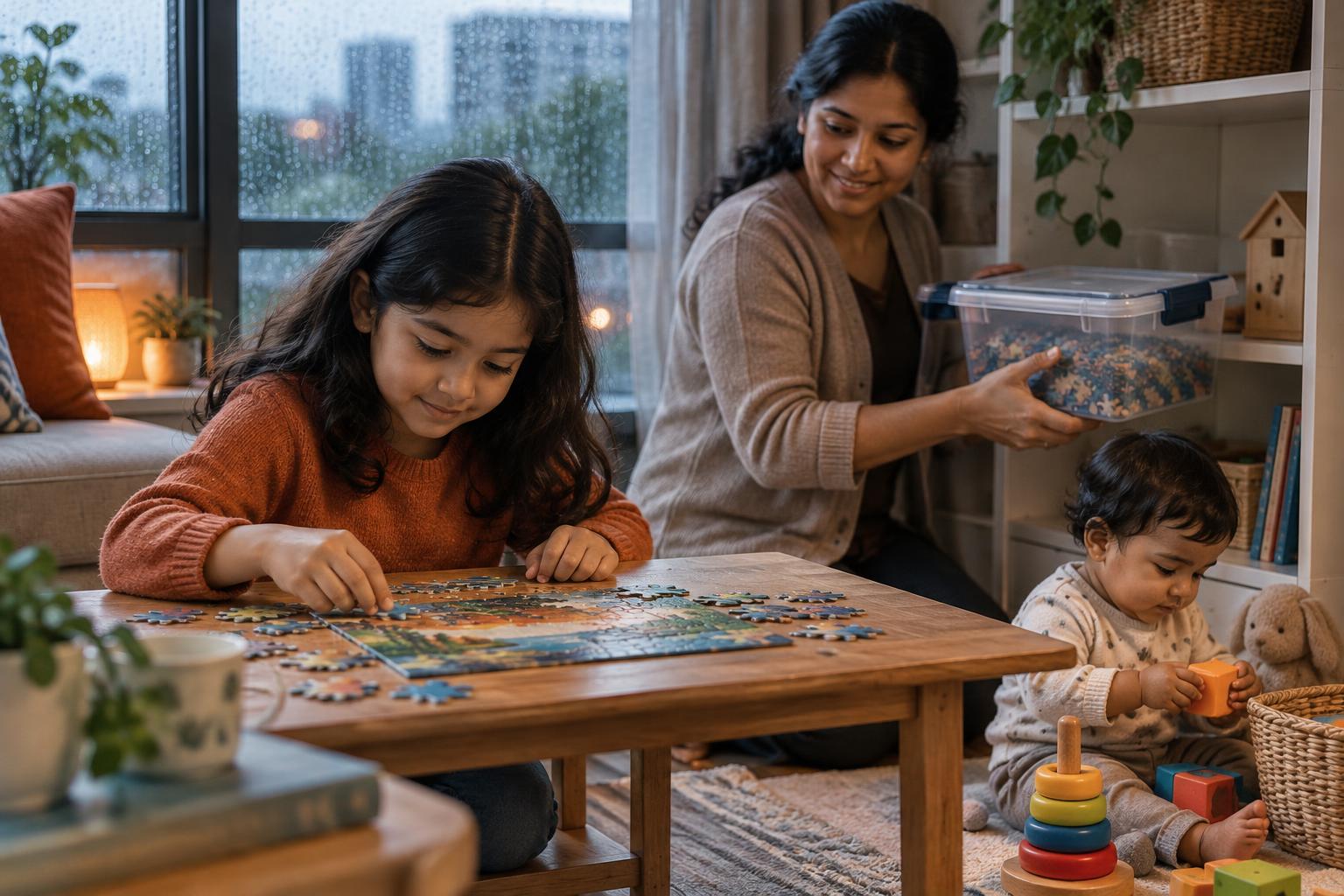
Your older child is working on a puzzle when a younger sibling crawls over to investigate. Within seconds, a loose piece can become something to taste. In a busy family home, keeping puzzle play safe takes more than saying, “Don’t touch.” A clear play area, secure storage and a consistent tidy-up routine help protect younger children without taking away an older child’s favourite activity.
Start with the youngest child’s safety
Small puzzle pieces can be choking hazards, especially for children under three. Older children who still put objects in their mouths also need protection from small parts. Choose toys according to the manufacturer’s age guidance and warnings, not only your child’s puzzle-solving ability.
Wooden does not automatically mean safer, and paper does not mean harmless. Check for small detachable parts, damaged pieces, splinters or peeling layers. Remove damaged items from play. Piece count and the overall size of a puzzle do not tell you whether individual pieces are suitable for a younger child.
When browsing wooden puzzles or paper puzzles, check the specific item’s safety information. If age suitability or piece dimensions are unclear, ask before buying rather than assuming.
Create a separate puzzle zone
The safest arrangement keeps younger children physically away from loose pieces while an adult supervises. A separate room with controlled access can work well. In a shared room, use an appropriate, securely fitted barrier and keep the younger child in a safe, supervised space.
- Choose a stable table away from edges where pieces could fall into the younger child’s area.
- Keep stools and chairs from becoming climbing routes to the puzzle.
- Use a shallow, raised-edge tray to help contain loose pieces.
- Avoid spreading small-piece puzzles on a shared floor, bed or sofa.
A high table alone is not a safety barrier. Pieces fall, toddlers climb, and older children sometimes carry pieces elsewhere. An adult still needs to monitor the play area and prevent access.
Pick a time you can supervise
Try puzzle time while another adult looks after the younger child, or during the younger child’s nap if you can supervise the older child and respond when the little one wakes. Keep sessions manageable rather than opening a large puzzle just before cooking, bathing or leaving home.
If the doorbell rings or you need to step away, pause the activity and secure every loose piece first. Do not ask the older sibling to act as the safety supervisor. They can practise careful habits, but preventing access remains an adult’s responsibility.
Give the younger sibling their own activity
A younger child may want to join simply because everyone else looks busy. Offer an age-appropriate activity in their separate supervised space: a board book, stacking cups or large-piece toys that meet the manufacturer’s guidance for that child.
You can explore toys grouped for ages 0–2 as a starting point, but check each product’s label and warnings. An age-category page is not a substitute for checking the individual toy.
Explain the arrangement warmly: “These little pieces stay with me and your sister. Here is your activity.” Avoid letting the younger child handle a small puzzle piece “just for a moment,” even while sitting on your lap.
Teach three simple rules
Keep instructions short enough for your older child to remember:
- Pieces stay in the puzzle zone. No carrying them into bedrooms, balconies or shared play spaces.
- Dropped piece? Tell an adult. Pause so it can be recovered immediately.
- Before leaving, pack away. Even a snack break needs a safe stopping point.
Praise specific actions: “You noticed that piece falling and told me.” If a piece goes missing, stay calm so your child feels comfortable reporting it. Keep the younger child out of the area until you have searched thoroughly and recovered it.
Make pack-up part of the game
Open only one puzzle at a time. Before play, establish how many pieces should be present; afterwards, check them against that count or a complete layout. Counting is useful, but it does not replace checking the room.
- Look under the table, chairs, rug edges and nearby furniture.
- Check clothing, pockets, trays and chair seats before children move away.
- Put pieces in a securely closed container, then inside a locked cupboard or otherwise inaccessible storage.
- Keep unfinished puzzles in secure storage too—not simply under a cloth.
A supplied box, including a metal tin, is not necessarily child-resistant. Ask grandparents, caregivers and visiting children to follow the same storage routine.
Know when to get urgent help
If a child cannot breathe, cry or cough effectively, treat it as an emergency: call Bangladesh’s emergency number, 999, and begin age-appropriate choking first aid if you know how. Do not blindly sweep inside the mouth with your fingers. Learning infant and child choking first aid from a qualified trainer is a valuable family precaution.
Safe puzzle play does not need a large home or complicated equipment. It needs a protected space, attentive adult supervision and a reliable habit: every piece secured before the next activity begins.