
Tangram Play · 29 Oct 2026 · Kids Essentials
Magnetic Wooden Tangram Puzzle Book: A Parent’s Guide to Play
Explore practical tangram activities, age-aware guidance and magnetic toy safety tips for playful learning at home.
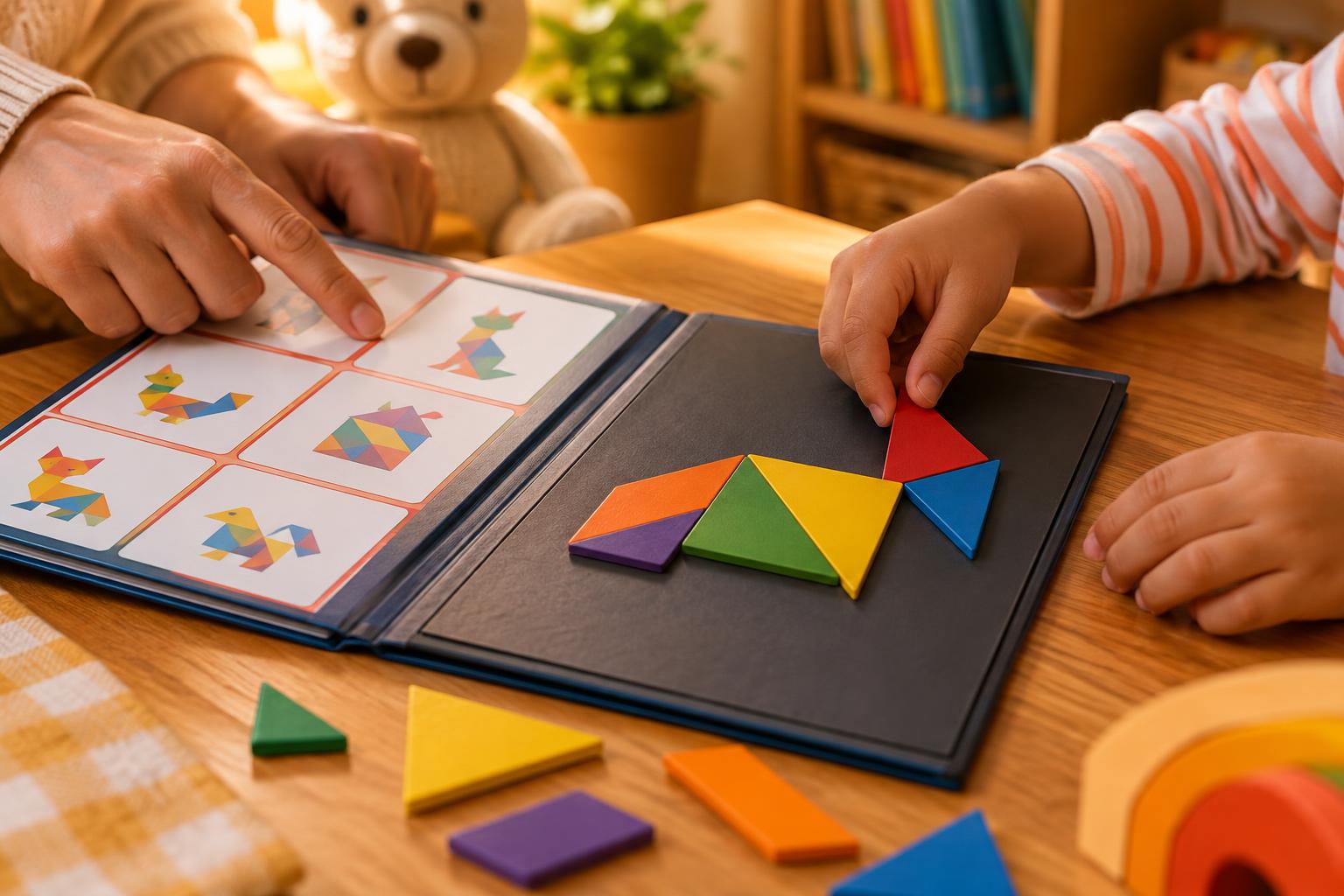
A few shapes, a little space and a question—“What could we make?”—can start a lovely screen-free activity. A magnetic wooden tangram puzzle book is worth considering for children who enjoy arranging pieces and making pictures. For parents, the key is choosing a suitable set and keeping play exploratory rather than turning it into another lesson.
Shop the Magnetic Wooden Tangram Puzzle Book
See the full contents, age guidance and price on the product page. View the puzzle book →
This guide explains how tangram play works, what to check before buying and how to introduce challenges at your child’s pace.
What is a tangram puzzle book?
A traditional tangram uses seven flat shapes: five triangles, one square and one parallelogram. These can be arranged into figures such as animals, people or boats. In a traditional challenge, the player uses all seven pieces without overlapping them to recreate an outline.
Products called tangram puzzle books can vary. Do not assume a particular set has seven pieces, a certain number of challenges or included solutions. Before buying, check the listed contents, dimensions, recommended age and instructions, including how the magnetic pieces and playing surface work.
Unlike a picture jigsaw, a tangram asks children to think about how shapes combine, rather than matching printed details. Both can be enjoyable; they simply offer different kinds of challenges.
Start with safety and suitability
Magnetic does not automatically mean suitable for toddlers. Small pieces can present a choking risk, and swallowed magnets can cause serious internal injury. Follow the manufacturer’s age guidance and warnings, and keep the set away from children who mouth objects.
- Check pieces before each session for cracks, splinters, damage or loose and exposed magnets.
- Stop using a damaged set; do not return a piece with a loose magnet to play.
- Supervise use and count pieces before and after the activity.
- Store the complete set somewhere younger siblings cannot reach.
If you suspect a child has swallowed a magnet, seek emergency medical care immediately, even if they seem well. Do not wait for symptoms.
For children aged one or two, choose a different toy specifically labelled suitable for their age and stage. Supervision does not make an unsuitable magnetic puzzle safe.
A gentle first session
Choose a clear table or floor space away from younger siblings. A quiet moment after a snack may work better than when your child is tired. Start with a few minutes and let their interest guide you.
1. Explore before solving
Invite your child to turn and compare the shapes. Ask, “Which has a long edge?” or “Can these two pieces sit together?” Use Bangla, English or both—whichever makes the conversation easiest. There is no need to test shape names.
2. Make one small picture
Use two or three pieces to invent something simple, perhaps a roof or a boat. Beginners do not need to follow the seven-piece rule. Let your child name the result, even if you see something different.
3. Try a model
If the book includes patterns, begin with one that shows the boundaries between pieces. An outline without those dividing lines is usually more demanding. Demonstrate one move, then give your child room to try.
Adjust the challenge, not the pressure
Age bands are starting points, not tests. Use these ideas only when the product’s safety guidance permits your child to use it.
- Ages 3–5: Try copying a two-piece arrangement you make beside them. Focus on placing, turning and noticing differences.
- Ages 5–7: Offer a simple pattern, then ask which piece might fit a particular corner. Encourage checking one possibility at a time.
- Ages 7–10: Try silhouette challenges, if provided, or invent a figure for someone else to copy. Ask your child to explain a useful strategy.
For more options, browse problem-solving toys, checking each item’s age recommendation rather than assuming every puzzle suits the same child.
Make the conversation useful
Tangram play gives children opportunities to practise turning shapes mentally, coordinating hand movements and testing ideas. These are opportunities for practice, not promises of improved intelligence or school results.
Instead of saying, “That is wrong,” try, “What happens if you turn it?” If frustration builds, offer a choice: “Would you like a hint, an easier picture or a break?” Notice effort specifically: “You tried another direction when the first one did not fit.”
For a creative finish, invite your child to build a fish, house or imaginary creature and tell a short story about it. You can find other open-ended activity ideas among creativity-focused toys.
Choose for your child’s interests
A tangram may appeal to a child who enjoys building and rearranging. A child who prefers completing a recognisable picture might enjoy exploring wooden puzzles instead. Neither preference is better.
Before choosing a magnetic wooden tangram puzzle book, confirm its contents and safety information. Then aim for shared discovery, not speed or perfect answers. A satisfying session can be as simple as trying a new arrangement, talking about it and putting every piece safely away together.
Shop the Magnetic Wooden Tangram Puzzle Book
See the full contents, age guidance and price on the product page. View the puzzle book →