Creative Play · 12 Oct 2026 · Kids Essentials
Finding Colours and Lines in Picture Puzzles: A Simple Start to Art
Turn picture puzzles into playful art explorations with simple colour hunts, line games and drawing ideas for children.
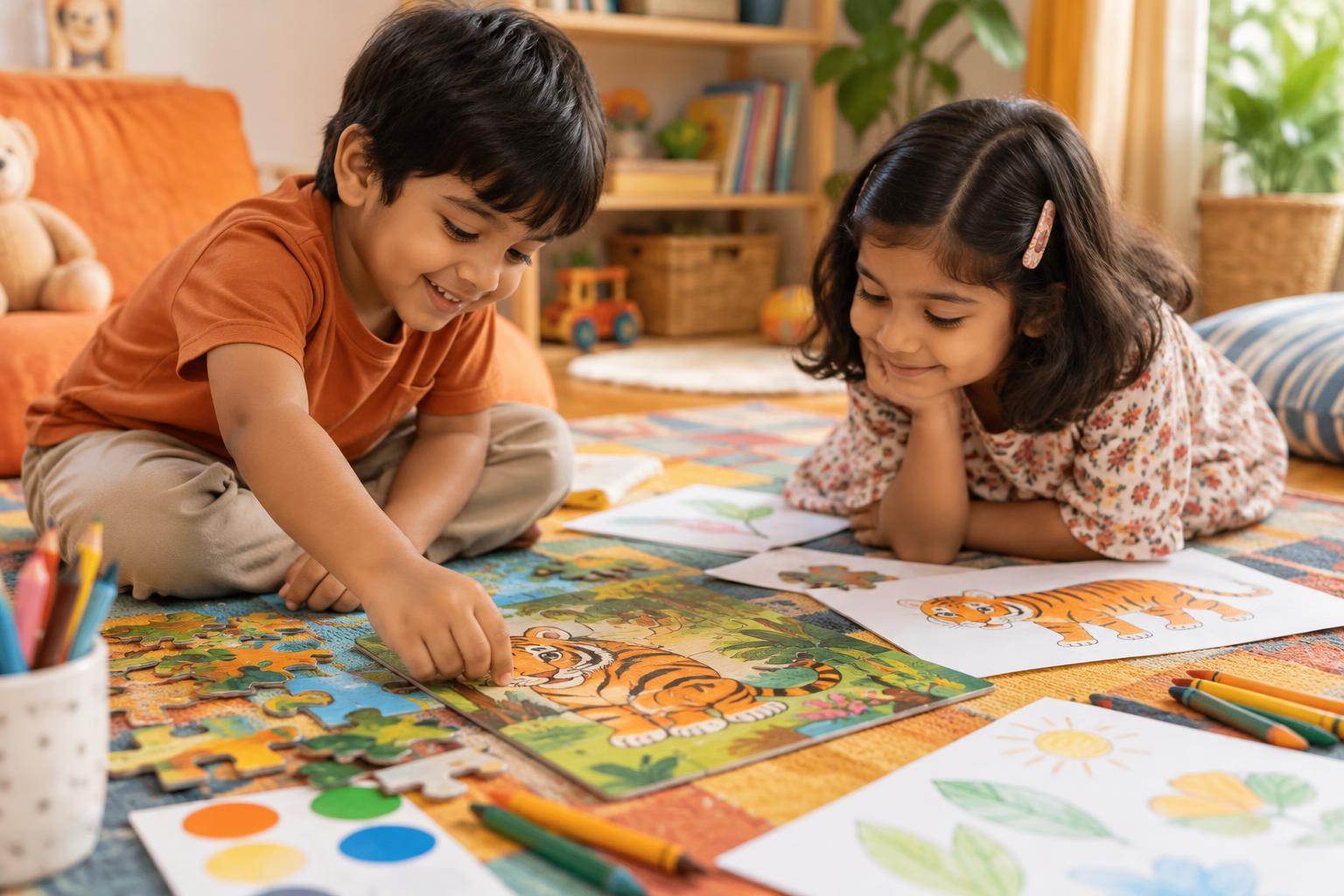
A child looking at a picture puzzle may notice a bright yellow patch before recognising the sun, or a curved line before spotting a fish. These small discoveries are a lovely starting point for art. You do not need a drawing class or expensive supplies: a suitable puzzle, some paper and a few crayons can be enough.
For families in Bangladesh, this can be a relaxed activity after school or on a rainy afternoon. The aim is not to produce a perfect picture. It is to help your child look closely, talk about what they notice and try making marks of their own.
Start with a picture, not a challenge
Choose an image your child finds interesting, with details they can comfortably notice. Use the box picture, a partly assembled puzzle or a finished section. There is no need to complete the puzzle before exploring its artwork.
If you are browsing wooden puzzles, look beyond the material and check the manufacturer's age guidance, piece size and difficulty. A higher piece count is not a better art lesson. Familiar pictures and manageable choices usually make it easier to begin.
Keep safety separate from ability: small puzzle pieces can be choking hazards, especially for children under three or those who still mouth objects. Follow age warnings, keep unsuitable pieces away and supervise closely. A younger child can enjoy looking at the picture while an adult keeps loose pieces out of reach.
Play a gentle colour-hunting game
Begin with one invitation: “Can you find something red?” Let your child point rather than requiring a colour name. You can name it afterwards in Bangla, English or both, using whichever language feels natural at home.
- Find a colour family: look for several blue areas. Do they all look the same?
- Compare two patches: ask which looks lighter or darker, without turning it into a test.
- Match a crayon: choose the closest available colour. An approximate match is fine.
- Make a colour collection: draw three small patches on paper using colours your child noticed.
If your child groups turquoise with green while you see blue, stay curious. Ask, “What does this colour remind you of?” Not every observation needs correcting, and colour words can come gradually.
Follow the lines hiding in the picture
Show your child that pictures contain different kinds of lines: straight fence posts, curved cheeks, wavy water or zigzag edges. Choose lines actually visible in your puzzle rather than expecting every picture to contain every type.
Trace a line in the air with your finger and invite your child to copy the movement. Then try it on paper. A broad arm movement may feel easier than a tiny pencil mark, especially for a younger child.
- Ask, “Where does this line bend?”
- Follow a pictured outline across two connected pieces.
- Compare a straight line with a curved one.
- Make a page of waves, loops or zigzags without drawing an object.
For older children who can manage a more involved puzzle, the 120-piece Starry Night paper puzzle is one option for a picture-based art session. Check its age guidance and preview the image before choosing it. Discuss the lines your child notices, rather than requiring knowledge about the artwork.
Turn looking into making
Draw a small detail
Instead of asking your child to copy the whole picture, invite them to choose one detail: a leaf, an eye or part of a roof. Ask, “Which mark would you make first?” Let them decide where to begin.
Borrow colours, change the subject
Your child might take three colours from the puzzle and use them to draw a rickshaw, a favourite animal or an imaginary garden. This keeps the activity creative rather than making accurate copying the goal.
Invent a line picture
Draw one wavy line on scrap paper and ask what it could become. A river? Hair? A winding road? Take turns adding marks. Keep crayons and pencils on paper, not on the puzzle pieces.
Adjust the invitation to your child
- Ages 1–3: focus on looking together, pointing and simple colour words. Offer age-appropriate drawing materials with supervision; avoid access to small pieces.
- Ages 3–5: try one colour hunt followed by a few large marks. Stop while the activity still feels enjoyable.
- Ages 5–7: compare shades, follow outlines and combine several line types in a drawing.
- Ages 7–10: explore how changing colours or lines changes a picture's mood. Invite their own interpretation.
These are flexible starting points, not milestones. Let your child's interests and comfort guide you.
Finish with curiosity, not a score
Try saying, “You used lots of curved lines,” instead of judging whether a drawing looks right. Ask whether your child wants to explain it, and accept a no. At Kids Essentials, we encourage keeping these moments simple: notice one colour, follow one line and leave room for your child's idea.